
Roofing in Spring City takes a lighter touch than almost anywhere in Utah. The entire town has been listed on the National Register of Historic Places as a historic district since 1980, largely because of its pioneer homes built from locally quarried oolite limestone. Beast Bros Roofing handles roof repair and roof replacement on those historic houses, on the farmsteads around town, and on the newer homes built in between. Spring City sits at around 5,800 feet on the east side of Sanpete Valley, so every roof also has to stand up to real mountain winters.
Roofing historic stone homes in Spring City
Many of Spring City's houses date to the 1860s through the 1890s. Danish stonemasons were among the settlers who built them, and the cream-colored oolite walls are why the town looks the way it does. Those same walls create specific roofing challenges:
- Roof-to-stone flashing. Where a roof meets a stone gable, parapet or chimney, the flashing has to be let into the mortar joints and lapped properly. Caulk smeared on the face of the stone fails within a few seasons, and water then runs behind the wall.
- Original plank decking. Homes first roofed with wood shingles usually have gapped boards underneath. We add solid sheathing before new shingles or metal go on.
- Soft old mortar. Historic lime mortar is softer than modern mortar. We take care not to damage it when setting counter-flashing, and we'll point out any masonry that needs a mason's attention.
- Additions and outbuildings. Rear kitchens, lean-tos, granaries and barns were added over generations, often with low-slope roofs that tie in awkwardly.
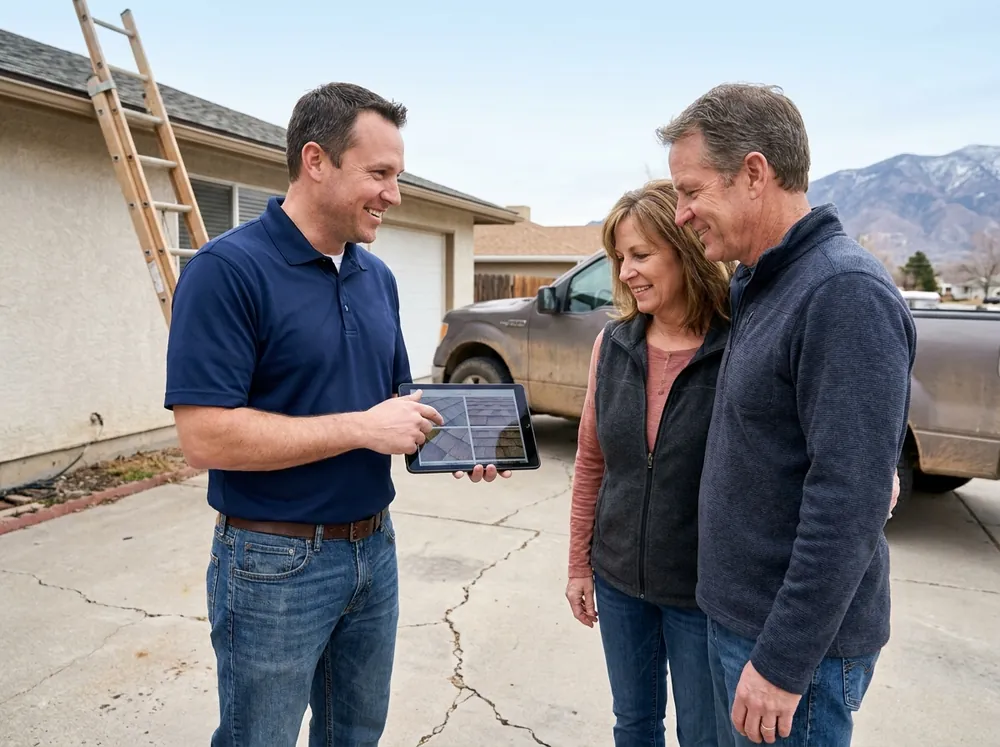
Before any work starts, we'll walk you through what we found with photos and explain the options. On a historic home, the goal is to keep the roof tight without changing what makes the house special. That usually means keeping the original rooflines, saving the stone chimneys that are still sound, and working carefully around old trim and cornices rather than tearing them out.
Choosing materials for a historic house
National Register listing honors the town's character, and most owners want a roof that fits it. Common choices here:
- Dimensional shingles in muted colors that read well on a pioneer-era home
- Standing seam metal, which has a long history on rural Utah buildings, sheds snow well and lasts for decades
- Matching the roofline, keeping original pitches, eaves and chimney locations rather than simplifying them
If you plan to use Utah's historic preservation tax credit for your project, talk to the State Historic Preservation Office before choosing materials. We're happy to work within those guidelines. Our metal roofing page covers standing seam options.
Roof repair in Spring City
Spring City's winters are cold and snowy, and the open fields west of town let the wind build up speed. The repairs we see most:
- Leaks at stone chimneys and gable walls where old flashing has failed
- Wind-lifted and missing shingles along ridges and rakes
- Ice dams on homes with thick stone walls but little attic insulation
- Loose or rusted metal panels on barns and outbuildings
Thick stone walls hold a lot of cold, and many of these homes were built long before anyone thought about attic insulation or ventilation. That's why ice dams show up here even on well-kept roofs. When we replace a roof, we look for practical ways to improve ventilation at the eaves and ridge without altering the look of the house. We trace every leak to its real source and fix it properly. See our roof repair page for how that works. For the metal-clad barns, granaries and shops on Spring City farmsteads, our pole barn exteriors service re-screws, re-roofs and re-sides existing buildings.
Serving Spring City and nearby towns
We work throughout Spring City and the farms around it. Nearby, we roof in Mount Pleasant just to the north and Ephraim to the south. Call (435) 529-8448 to set up a free inspection.